The Usurper’s Son
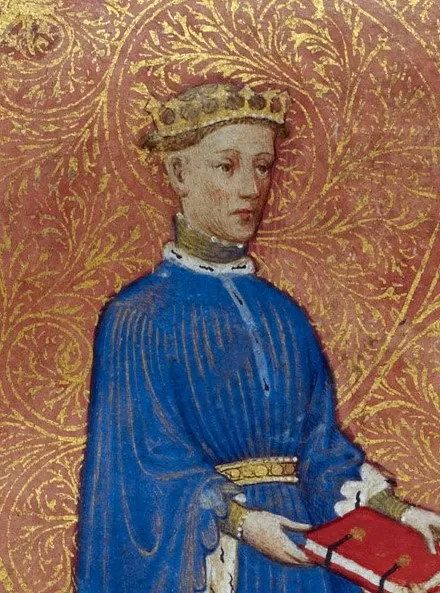
Henry was born in 1386 at Monmouth Castle on the Welsh border, the son of Henry Bolingbroke, son of John of Gaunt. In 1399 Bolingbroke overthrew his cousin Richard II and became Henry IV, and the twelve-year-old Henry became Prince of Wales.
The new dynasty was insecure, and rebellions broke out one after another. At the Battle of Shrewsbury in 1403 the sixteen-year-old prince was struck in the face by an arrow, the head lodging deep in the bone. The royal surgeon John Bradmore made a special instrument to draw it out without damaging anything vital, then dressed the wound with honey. Henry recovered, though he was scarred for life. For the next few years he fought Owain Glyndŵr’s rebels in Wales and gained wide military experience.
Shakespeare’s “Prince Hal” is a wild youth who drinks with Falstaff and reforms only when he becomes king. That picture is largely later legend: in fact Henry was running government and war while still young, though he did quarrel with his father over policy towards the end of the old king’s reign.
King
Henry IV died in 1413, and Henry V was crowned in a snowstorm. Devout and stern, he crushed a Lollard rising and foiled a plot to put the Earl of March on the throne. To secure his dynasty he turned to France: Charles VI of France was mentally ill and the French nobility was split between the Burgundians and the Armagnacs — the perfect moment to revive the English claim to the French crown.
Agincourt
In August 1415 Henry crossed the Channel and besieged the Norman port of Harfleur. The town fell, but dysentery had ravaged his army, and Henry decided to march overland to Calais. On 25 October, St Crispin’s Day, his exhausted army found its way blocked at Agincourt by a French force several times its size.
Heavy rain had turned the fields to mud. The French knights and men-at-arms, in full armour, floundered forward and made easy targets for the English longbowmen, and as the front ranks fell they blocked those behind. Within a few hours a great part of the French nobility had been killed or captured, while English losses were light. During the battle, fearing a fresh French attack, Henry ordered most of the prisoners to be killed — a decision still debated today.
Agincourt made Henry famous across Europe. When he returned, Londoners lined the streets to cheer him, but he forbade songs in his praise and gave the glory to God.
The Conquest of Normandy
From 1417 Henry methodically captured the towns of Normandy. During the siege of Rouen in 1418–19 the garrison expelled civilians who could not fight, but Henry refused to let them through his lines, and many women and children starved in the ditch between the walls and the besiegers. Rouen surrendered in 1419, and Normandy was English once more.
That year the Duke of Burgundy was murdered at a meeting with the French Dauphin, and the Burgundians went over to the English. In May 1420 Henry and Charles VI signed the Treaty of Troyes: Henry became regent and heir of France, and the Dauphin was disinherited. In June Henry married Charles’s daughter Catherine of Valois at Troyes, and in December 1421 their son, Henry VI, was born at Windsor.
Champion of English
Henry V was the first English king to write his own letters and official documents regularly in English. From 1417 most of his signet letters were in English, government offices followed suit, and London’s clerks gradually developed a standard written English. English was replacing French as the common language of government and society.
Early Death
In 1422, while besieging Meaux, Henry caught dysentery, and he died at the castle of Vincennes outside Paris on 31 August, aged thirty-five. Charles VI died two months later, and the infant Henry VI became king of both England and France.
Henry V was buried in Westminster Abbey. Had he lived longer he might really have united the crowns of England and France; but his son was a child and grew up weak, all England’s French lands were lost within thirty years, and England fell into the Wars of the Roses. Around 1599 Shakespeare wrote Henry V, whose lines — “We few, we happy few, we band of brothers” — made Henry England’s most famous warrior king.