A Prince Raised in Civil War
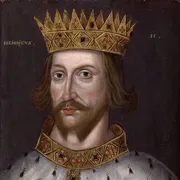
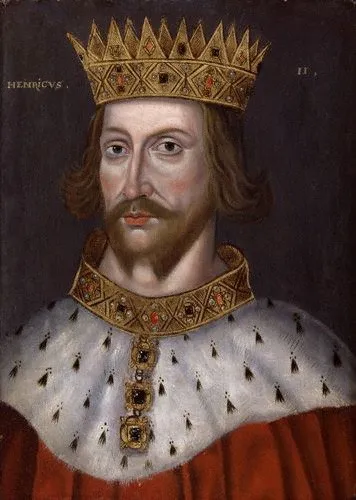
Henry was born at Le Mans in western France on 5 March 1133, the son of Count Geoffrey of Anjou and Empress Matilda, daughter of King Henry I of England. When his grandfather died, his mother’s cousin Stephen seized the throne and civil war followed. As a teenager Henry crossed to England more than once to fight; on one occasion, unable to pay his men, he had to ask Stephen himself for the money to send them home.
In 1150, aged seventeen, Henry was given Normandy by his father, and on his father’s death the next year he inherited Anjou too. In 1153 he landed in England with an army; Stephen, whose eldest son had just died, made peace and recognised Henry as his heir. When Stephen died the following year, the twenty-one-year-old Henry was crowned King of England.
The Angevin Empire
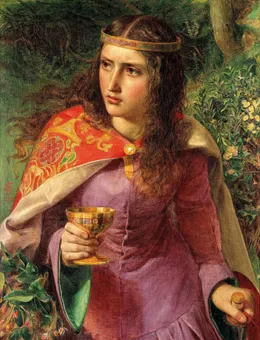
In 1152 Henry married Eleanor of Aquitaine, newly divorced from Louis VII of France. About eleven years his senior, she brought him the great duchy of Aquitaine in south-western France. Henry now ruled from the Scottish border to the Pyrenees — more land than his nominal overlord, the King of France, held directly. Historians call it the Angevin Empire. In 1171 he went to Ireland to receive the submission of its lords.
Henry had boundless energy and spent his life in the saddle, rarely staying anywhere long. It was said he could not sit still, and worked on documents even during Mass.
Founder of the Common Law
After years of civil war England was in disorder. Henry pulled down the barons’ unlicensed castles, recovered royal lands and, above all, reformed justice. He sent judges regularly around the shires to try cases in a uniform way; the Assize of Clarendon of 1166 required sworn local men to report crimes, an early form of the jury; and he made wide use of royal writs so that disputes over land could be brought swiftly before the king’s courts.
These measures grew into a “common law” for the whole kingdom, replacing a patchwork of local customs. The legal traditions of Britain, the United States, Hong Kong and every other common-law jurisdiction trace their roots to Henry II’s reforms.
The Becket Affair
Thomas Becket, the son of a London merchant, was Henry’s chancellor and close friend. In 1162 Henry made him Archbishop of Canterbury, expecting to control the Church through him. Instead Becket became a fierce defender of the Church’s rights, refusing to let clergy accused of crimes be tried in royal courts. The two men fell out completely, and Becket spent six years in exile in France.
Soon after his return in 1170 he clashed with the king again. In a rage Henry is said to have cried, “Will no one rid me of this turbulent priest?” Four knights rode to Canterbury and on 29 December killed the archbishop in his cathedral. Europe was shocked; Becket was made a saint three years later, and Canterbury became one of Europe’s great shrines. In 1174 Henry walked barefoot into Canterbury Cathedral and submitted to a flogging by the monks in public penance.
Betrayed by His Sons
Henry’s greatest troubles in later life came from his own family. His sons resented being given titles without power, and in 1173 they rebelled with the backing of Queen Eleanor and Louis VII. Henry crushed the revolt and kept Eleanor captive for sixteen years. His eldest son, Henry the Young King, and his son Geoffrey both died, and Richard then allied with Philip II of France against his father.
In 1189 the ailing Henry was defeated and forced to make peace. On seeing that the list of rebels included his favourite, his youngest son John, he is said to have lost the will to live; he died a few days later at Chinon, murmuring, “Shame, shame on a conquered king.” He was buried at Fontevraud Abbey, where Eleanor and Richard I were later laid beside him.