The Boy King
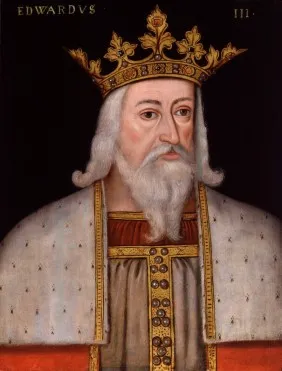
Edward was born at Windsor Castle on 13 November 1312, the son of Edward II and Isabella of France, daughter of Philip IV of France. Edward II’s favourites — Piers Gaveston and then the Despensers, father and son — set the barons and the queen against him. In 1326 Isabella and her lover Roger Mortimer invaded from France, and the next year forced Edward II to abdicate; the fourteen-year-old Edward was made king. The deposed king soon died at Berkeley Castle, almost certainly murdered.
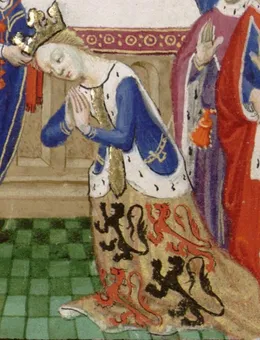
In 1328 Edward married Philippa of Hainault at York. He was king in name, but power lay with his mother and Mortimer. In October 1330 the seventeen-year-old Edward and a band of loyal friends crept through a secret passage into Nottingham Castle and seized Mortimer, who was later executed in London; Isabella retired to the country. From then on the young king ruled in person.
The Hundred Years’ War
When the Capetian kings of France died out in 1328, Edward claimed the French throne through his mother, but the French nobility chose Philip VI of Valois. Quarrels over Gascony and Scotland added to the tension, and in 1337 war broke out — the beginning of the Hundred Years’ War.
In 1340 the English fleet destroyed the French navy at Sluys and won command of the sea. At Crécy on 26 August 1346 the English longbowmen shattered a far larger French army of mounted knights. When the king was told that his sixteen-year-old son, the Black Prince, was hard pressed and was asked to send help, Edward replied, “Let the boy win his spurs.” The English then besieged Calais for almost a year. When the town fell, six burghers offered their lives to save the rest, and the king spared them only at Queen Philippa’s plea — the famous Burghers of Calais. Calais remained English for more than two hundred years.
In 1356 the Black Prince captured King John II of France at Poitiers. By the Treaty of Brétigny of 1360 Edward gave up his claim to the French throne in return for full sovereignty over the whole of Aquitaine and an enormous ransom. It was England’s finest hour in the Hundred Years’ War.
The Garter and Chivalry
Edward loved the culture of chivalry and liked to see himself as a new King Arthur. Around 1348 he founded the Order of the Garter, limited to twenty-six members, still Britain’s highest order of knighthood. Legend says that a countess lost her garter at a ball, and the king picked it up and tied it round his own leg, declaring, “Honi soit qui mal y pense” — “shame on him who thinks evil of it” — which became the order’s motto. He also rebuilt Windsor Castle, where he had been born, on a grand scale, making it the chief royal residence.
The Black Death and a Changing Society
The Black Death reached England in 1348 and within a year or two killed between a third and a half of the population; Edward’s own daughter Joan died of it on her way to be married in Spain. The shortage of labour drove wages up, and the government’s attempts to cap them by statute angered peasants and workers — sowing the seeds of the Peasants’ Revolt of 1381.
Constant war needed constant money, so the king had to summon Parliament again and again. Parliament gradually divided into two houses, and the Commons grew in importance. In 1362 Parliament ordered that pleas in the law courts should be conducted in English, and in the same year Parliament was opened in English for the first time. English was on its way to replacing French as the language of government.
Last Years
In old age Edward’s energy failed. After Philippa’s death in 1369 he fell under the influence of his mistress, Alice Perrers. France recovered, and most of England’s French lands were lost. In 1376 the Black Prince died before his father; that same year the “Good Parliament” impeached the king’s favourites and banished Perrers from court — the first time Parliament used the power of impeachment.
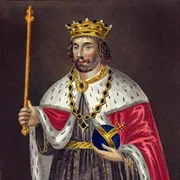
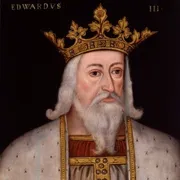
Edward died at Sheen Palace on 21 June 1377; it was said that Perrers slipped the rings from his fingers as he lay dying. The crown passed to the Black Prince’s ten-year-old son, Richard II. Edward III reigned for fifty years and was a hero to his subjects in his lifetime — but the descendants of his many sons, among them John of Gaunt and Edmund, Duke of York, would fight over the crown in the next century in the Wars of the Roses.