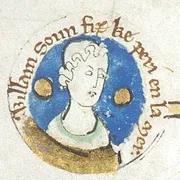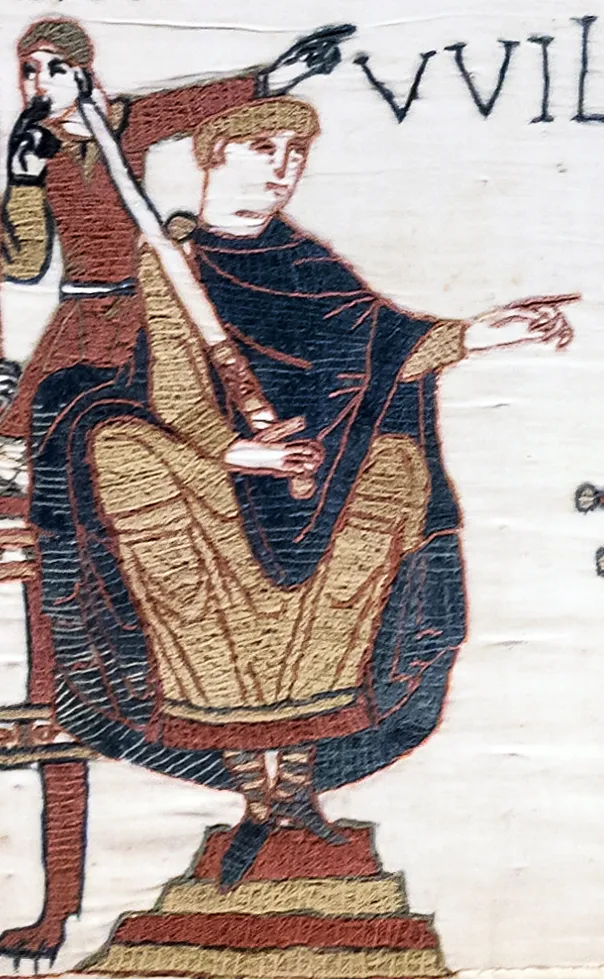
William I

House of Normandy

William I

威廉一世Guillaume le Conquérant

“the Conqueror”

Born
1028, Falaise
Died
9 September 1087, Rouen

The illegitimate son of the Duke of Normandy, he inherited the duchy as a child amid turmoil. In 1066 he defeated Harold II at Hastings and became King of England, securing his rule with castles and feudal lordship and ordering the Domesday survey of 1086.

The Bastard Duke

William was born around 1028 at Falaise in Normandy. His father was Duke Robert I of Normandy; his mother, Herleva, was the daughter of a local tanner, and the two never married. Before he conquered England, he was usually known as William the Bastard.

In 1035 Robert set out on pilgrimage to Jerusalem and died at Nicaea on the way home. The seven- or eight-year-old William inherited the duchy, and Normandy fell into chaos: nobles fought one another and several of his guardians were murdered. In 1047, aged about twenty and with the help of King Henry I of France, William defeated the rebel barons at Val-ès-Dunes and gradually brought the whole duchy under control.

Around 1051 he married Matilda, daughter of the Count of Flanders. The pope at first objected on grounds of kinship; the couple are said to have founded the two great abbeys of Caen, for men and for women, in penance. They were devoted to each other and had nine children.

The Claim to England

William had old ties to the English royal house: King Edward the Confessor’s mother, Emma, was William’s great-aunt, and Edward had spent more than twenty years in exile in Normandy. According to Norman writers, Edward promised William the throne in 1051, and around 1064 the English nobleman Harold Godwinson, shipwrecked and delivered into William’s hands, swore on holy relics to support his succession. These claims come only from the Norman side; English sources say nothing of the kind.

When Edward died in January 1066, Harold was crowned at once. William denounced him as an oath-breaker, won the backing of Pope Alexander II, and assembled several hundred ships and some seven thousand men.

Hastings

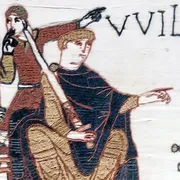
On 28 September 1066 William landed at Pevensey on the south coast. Harold had just defeated King Harald Hardrada of Norway at Stamford Bridge in the north, and marched south at once. On 14 October the two armies met on a hillside near Hastings. The English infantry held the hilltop in a shield wall, and the Norman cavalry charged again and again without success. At one point a rumour spread that William had been killed, and he pushed back his helmet to show his face and steady his men. The Normans then feigned retreat, drew English soldiers down from their position, and turned to cut them off. By dusk Harold was dead and the English army had broken.

The Bayeux Tapestry depicts the battle; its image of a soldier with an arrow in his eye has traditionally been taken as Harold’s death, though historians still debate it. On Christmas Day William was crowned King of England in Westminster Abbey.

Rule by Iron

The coronation was only the beginning. For five years rebellions broke out across England. After a northern rising in 1069, William spent the winter burning villages, livestock and stores of food across Yorkshire and beyond, and great numbers died of famine. The Harrying of the North was thought cruel even at the time.

William built castles throughout the kingdom; the White Tower of the Tower of London was begun in his reign. He confiscated the lands of the English nobility and granted them to the Norman knights and clergy who had followed him, who owed the king loyalty and military service in return. By the end of his reign almost all the great landholders of England were Normans, as were most bishops. In 1070 he made the Italian scholar Lanfranc Archbishop of Canterbury to reform the English Church.

Domesday Book

At Christmas 1085, after consulting his council at Gloucester, William sent commissioners throughout England to record who held every piece of land, how large it was, its ploughs, mills and value. The record completed the next year came to be called Domesday Book — because, like the Last Judgement, there was no appeal from it. It is the most detailed survey of medieval Europe and is still kept at the National Archives.

Last Years and Legacy

In old age William quarrelled with his eldest son Robert. In 1079 father and son met in battle at Gerberoy, where William was wounded and unhorsed by his own son. Queen Matilda’s death in 1083 left him grief-stricken. In 1087 he was injured while campaigning at Mantes in France, and he died at Rouen on 9 September. He was buried in the Abbey of Saint-Étienne at Caen.

The Norman Conquest transformed England. The Anglo-Saxon aristocracy was replaced by a Norman one; Norman French was spoken at court for three hundred years, and English absorbed a vast number of French words; stone castles and cathedrals replaced timber halls; and England’s destiny was bound to France for centuries. Every later monarch of England and Britain is descended from William.
Matrimonium

Marriages & Children

Marriage 1

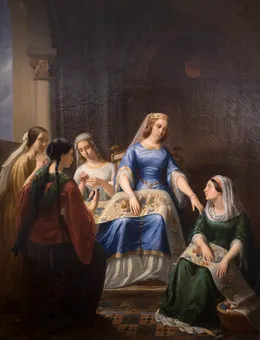
Matilda of Flanders

1031–1083◆Married 1051, Eu

The wedding took place around 1051–52. The pope at first objected on grounds of kinship; the couple are said to have founded the two great abbeys of Caen, for men and for women, in penance.

Children

Stemma

Family Tree

Parents, grandparents, spouses and descendants. Gold frames mark monarchs of England or Britain; diamonds mark marriages, with the year alongside. Select a person to open their entry.

William I1028–1087
Robert Curthose1051–1134
William II1056–1100
Henry I1068–1135
Stephen1092–1154
Empress Matilda1102–1167
William Adelin1103–1120
1100
1051

Imperium

The Changing Map

LondonWinchesterYorkHastingsRouenCaenParisAngersEdinburghLincoln106610871135
  • Kingdom of England
  • Duchy of Normandy
  • Welsh principalities
  • Kingdom of Scotland
  • England (William II)
  • Normandy (Robert)
  • Welsh principalities
  • Kingdom of Scotland
  • Kingdom of England
  • Duchy of Normandy
  • County of Anjou (Matilda's husband)
  • Welsh principalities
  • Kingdom of Scotland

Borders are indicative only, approximated from modern administrative regions.

  1. 1066

    1066: The Norman Conquest

    After William's victory at Hastings, England and the duchy of Normandy shared a ruler. Normandy remained a fief of the French king, so the King of England was also the French king's vassal — the start of centuries of Anglo-French entanglement.

  2. 1087

    1087: The brothers divide

    After William I's death his eldest son Robert took Normandy and his third son, William II, England. In 1106 Henry I defeated Robert at Tinchebrai and reunited the two.

  3. 1135

    1135: On the eve of the Anarchy

    Henry I ruled England and Normandy and married his daughter Matilda to Geoffrey, heir to Anjou. When Henry died his nephew Stephen seized the crown, and Geoffrey used the civil war to conquer Normandy, preparing the way for his son Henry II's "Angevin Empire".

Chronica

Chronology

  1. 106614 October 1066

    Battle of Hastings

    Norman cavalry and archers fought Harold's shield wall all day; Harold was killed and the English army broke.

  2. 106625 December 1066

    William crowned King of England

    William was crowned in Westminster Abbey. Norman guards outside, mistaking the acclamation for a riot, set fire to nearby houses.

  3. 1069

    The Harrying of the North

    After a northern rising, William laid waste to Yorkshire and beyond in the winter of 1069–70, burning villages, livestock and food; many died of famine.

  4. 1086

    Domesday Book

    William sent commissioners to survey the land, people and wealth of England; the results became Domesday Book, the most detailed survey of medieval Europe.

  5. 10879 September 1087

    Death of William I

    Injured while campaigning at Mantes, William died at Rouen weeks later. Robert received Normandy and William Rufus England.

Examen

Quiz

  1. 01Before the Conquest, what was William usually called?

  2. 02On what grounds did William claim the English throne?

  3. 03Less than three weeks before Hastings, where did Harold II defeat the King of Norway?

  4. 04What is the name of the survey of land and property completed in 1086?

Further Reading

  • Bates, David. William the Conqueror. New Haven: Yale University Press, 2016.
  • Douglas, David C. William the Conqueror: The Norman Impact upon England. London: Eyre & Spottiswoode, 1964.
  • Morris, Marc. The Norman Conquest. London: Hutchinson, 2012.

Image Credits

  • Adela of Normandy — Unknown author, 13th century. Wikimedia Commons, Public domain.
  • Empress Matilda — PurpleHz, 2006-11-17. Wikimedia Commons, Public domain.
  • Henry I — Matthew Paris, circa 1255. Wikimedia Commons, Public domain.
  • Matilda of Flanders — Alfred Guillard, 1848. Wikimedia Commons, CC BY-SA 4.0.
  • Matilda of Scotland — engraved by W. H. Mote (1803-1871) after an illustration by J.W. Wright, 19th century. Wikimedia Commons, Public domain.
  • Robert Curthose — Unknown author, 2016-04-05. Wikimedia Commons, Public domain.
  • Robert I, Duke of Normandy — Michael Shea, imars. Wikimedia Commons, CC BY-SA 2.5.
  • Stephen — Matthew Paris, 13th century. Wikimedia Commons, Public domain.
  • William Adelin — Unknown author, 13th century. Wikimedia Commons, Public domain.
  • William I — Unknown embroiderers (Bayeux Tapestry); photo: Myrabella, 1070s. Wikimedia Commons, Public domain.
  • William II — Matthew Paris, 1255. Wikimedia Commons, Public domain.
  • Dürer, Triumphal Arch — Unknown embroiderers (Bayeux Tapestry), 2011-10-27. Wikimedia Commons, Public domain.