
French-Speaking Kings of England
England and France have been entangled since the Norman Conquest of 1066. William the Conqueror was both King of England and Duke of Normandy, a vassal of the King of France; for the next three hundred years the English court and aristocracy spoke French. English still carries the trace: the animal in the field is a cow or a pig, but the meat on the table is beef or pork, from the French of the Norman lords. The royal motto, Dieu et mon droit, and the motto of the Order of the Garter, Honi soit qui mal y pense, are still written in French.
In 1154 Henry II, son of the Count of Anjou, inherited the English throne. Together with the lands he had from his parents and his wife Eleanor of Aquitaine, his domains reached as far as the Pyrenees — the “Angevin Empire” — and he held more of France than the French king himself. No French king could accept that. In 1204 Philip II of France took Normandy from King John, and by the Treaty of Paris of 1259 Henry III formally gave up Normandy, keeping only Gascony, for which he did homage to the King of France.
The Hundred Years’ War
In 1328 the Capetian kings of France died out. Edward III’s mother, Isabella, was the daughter of Philip IV of France, and Edward claimed the French throne through her; the French nobility instead invoked the custom that the crown could not pass through a woman, and chose Philip VI of the House of Valois. In 1337 a war broke out that would last more than a century.
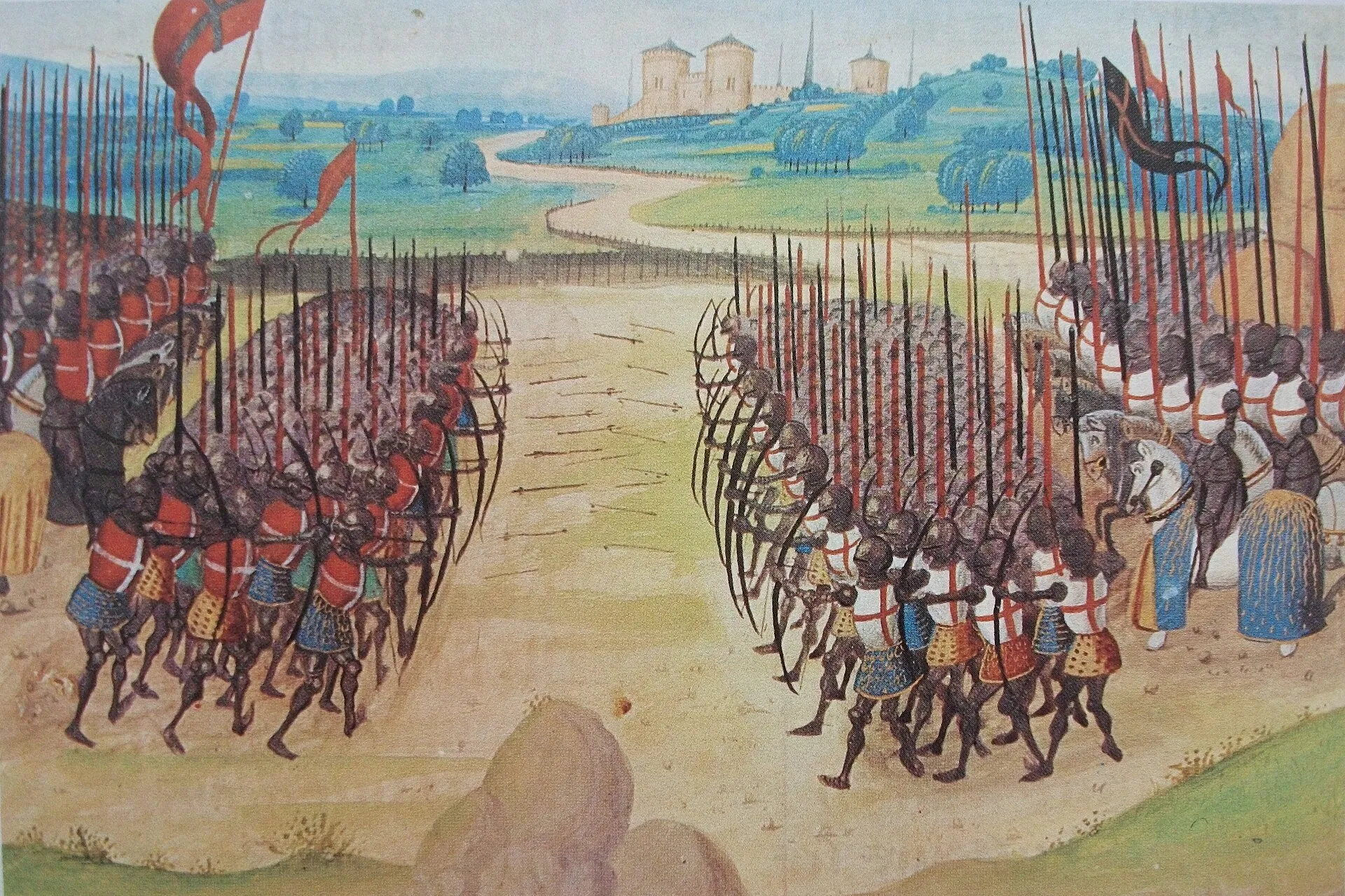
The English armies, famous for their longbowmen, won battle after battle against larger forces: at Crécy in 1346 and at Poitiers in 1356, where Edward the Black Prince captured King John II of France. In 1415 Henry V crushed the French at Agincourt, and under the Treaty of Troyes of 1420 he married the French princess Catherine of Valois and became heir to the throne of France. Henry died two years later, and his infant son Henry VI was for a time king of both England and France, crowned in Paris in 1431.
The tide turned in 1429, when Joan of Arc, a peasant girl, raised the siege of Orléans and put new heart into the French. After the Battle of Castillon in 1453 England lost all its French lands except Calais, and in 1558, under Mary I, Calais too was lost. Even so, English monarchs went on styling themselves “King of France” until 1801.
The Second Hundred Years’ War
After the Reformation, Protestant England and Catholic France grew further apart. France had a long-standing alliance with Scotland, the “Auld Alliance”, and Louis XIV backed the exiled James II and his heirs. Between 1689 and 1815 the two countries fought again and again in Europe, North America and India — a struggle historians call the “Second Hundred Years’ War”:
- in the War of the Spanish Succession, the Duke of Marlborough routed the French at Blenheim in 1704;
- at the end of the Seven Years’ War Britain had won Canada and gained the upper hand in India;
- in the American War of Independence France sent forces to help the colonists, and Britain lost the Thirteen Colonies;
- in the Napoleonic Wars Nelson destroyed the French and Spanish fleets at Trafalgar in 1805, and the Duke of Wellington defeated Napoleon at Waterloo in 1815.
From Enemies to Allies
After Waterloo Britain and France never fought each other again. In 1854 they joined forces against Russia in the Crimea, and the following year Queen Victoria visited Paris — the first English monarch to make a state visit to the French capital since the Hundred Years’ War. By the end of the century both countries felt threatened by the rise of Germany. In 1903 Edward VII visited Paris and won over the French public with his charm; the next year the two countries signed the Entente Cordiale, settling their colonial disputes. Ten years later, in the First World War, they fought side by side.
From the Norman Conquest to the Entente Cordiale, the relationship lasted more than eight hundred years, and the languages, monarchies and national identities of both countries took shape in rivalry with each other.